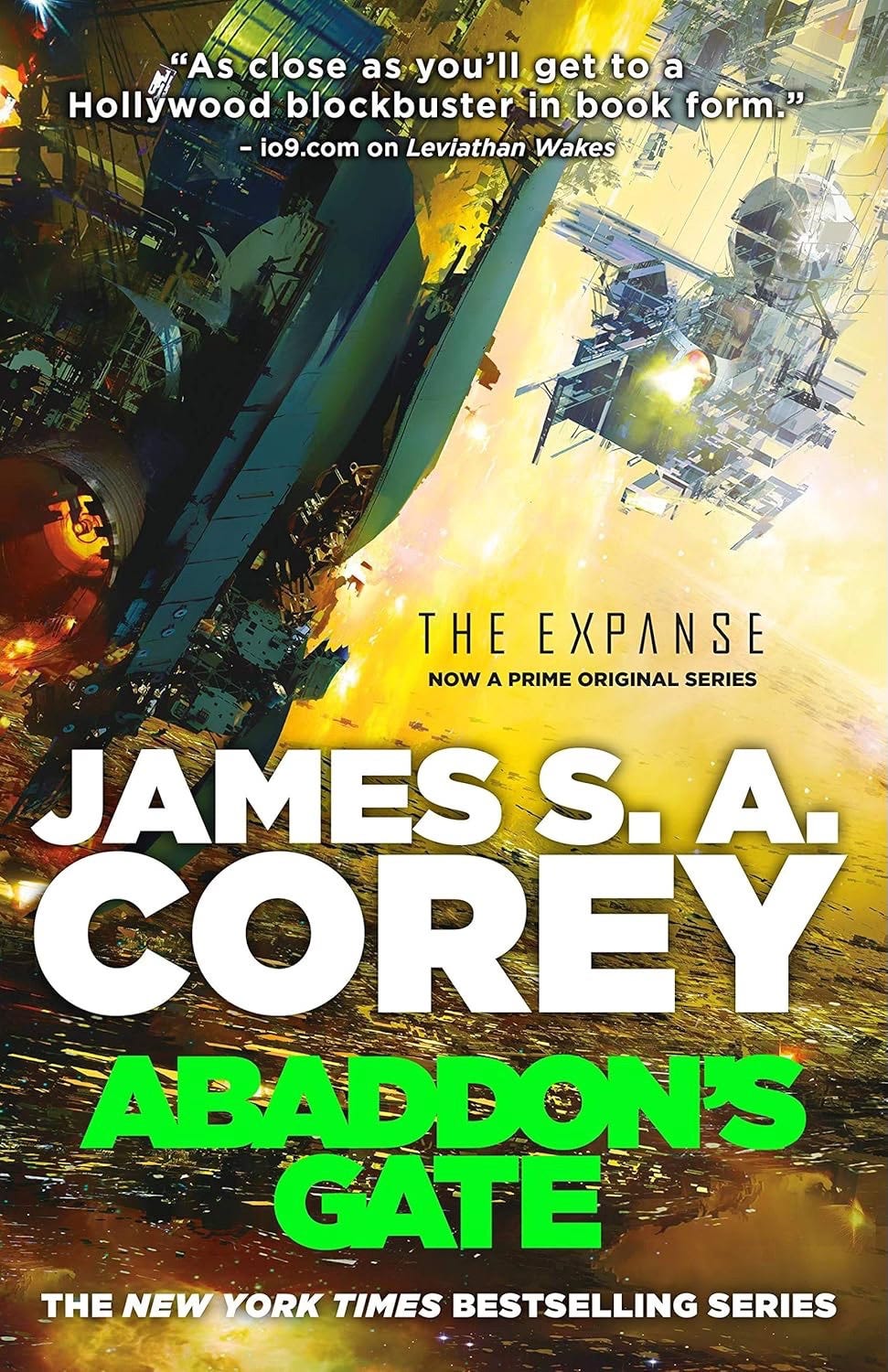
Abaddon’s Gate (Expanse, #3)
When blockbuster sci-fi knows exactly what it is - and pretends nothing else

“Heroism is a label most people get for doing shit they’d never do if they were really thinking about it”
I owe James S.A. Corey an apology.
I came to Leviathan Wakes with low expectations. After a run of disappointing science fiction, I wasn’t looking for transcendence — I was looking for something competent. What I found instead was one of the most consistently entertaining trilogies I’ve read in years.
Abaddon’s Gate confirms that this wasn’t an accident.
It doesn’t reinvent the formula of the first two books; it refines it. The momentum is still there. The political escalation continues. The stakes rise. But there’s a tonal shift that surprised me. The introduction of Anna, the pastor, brings a quieter moral and spiritual dimension into what could have remained pure propulsion. Her presence adds texture without slowing the engine — and that balance is harder to achieve than it looks.
The Clarissa (Melba) arc, meanwhile, adds emotional friction and personal obsession into the larger geopolitical chaos. I enjoyed it, though part of me felt there was even more psychological depth waiting to be mined there. The material was strong — perhaps strong enough to carry an even heavier moral weight. I guess there was a missed opportunity there, or at least part of me wanted to be a bit more grit.
Having now read the three main novels along with The Butcher of Anderson Station, Gods of Risk, and Drive, what stands out most is discipline. This is pulp fiction, yes — unapologetically so — but it is engineered pulp. The world-building is coherent. The science remains grounded enough to feel plausible. The political mechanics are believable. Nothing feels random or careless.
“Violence is what people do when they run out of good ideas. It’s attractive because it’s simple, it’s direct, it’s almos always available as an option. When you can’t think of a good rebutal for your opponent’s argument, you can always punch them in the face”
Now, let’s address something honestly.
If you come to this series expecting the moral corrosion of Joe Abercrombie (Joe is my modern reference in sff) — if you crave existential decay, compromised antiheroes, and ethical ambiguity that gnaws at you — this is not that. The moral architecture here is comparatively clean. The heroes are recognizably heroic. There is a persistent blockbuster sheen, at times almost a Disney patina. You won’t find a deep philosophical excavation of human consciousness. But that clarity is not a weakness. It’s intentional.
The Expanse knows what it is: a high-stakes, politics-driven, scientifically grounded space opera that moves relentlessly forward. It doesn’t pretend to be Lem. It doesn’t pretend to be Watts. It doesn’t pretend to dismantle the human condition. It delivers momentum, escalation, and narrative control — and it does so with precision.
If I have one reservation, it’s that the ending of Abaddon’s Gate feels slightly accelerated compared to the complexity that precedes it. There are stretches where the book feels heavier, even stalled at moments, making it perhaps the most uneven of the three. But even that doesn’t diminish the overall accomplishment.
Three books in, what impresses me most is cohesion. This universe holds together. The spectacle never dissolves into chaos. The escalation feels earned, and you never feel truly lost in the plot.
This trilogy may not be a timeless philosophical monument in science fiction — but as blockbuster space opera executed with discipline and respect for the reader, it stands comfortably near the top of the podium.
And yes, I’m continuing.